math104-s21:hw10
Differences
This shows you the differences between two versions of the page.
| Both sides previous revision Previous revision Next revision | Previous revision | ||
|
math104-s21:hw10 [2021/04/13 22:27] pzhou |
math104-s21:hw10 [2022/01/11 18:30] (current) 24.253.46.239 ↷ Links adapted because of a move operation |
||
|---|---|---|---|
| Line 6: | Line 6: | ||
| - | 3. (3 pt) Let $f(x) = x^4(2 + \sin(1/x))$ for $x \neq 0$ and $f(0)=0$. Compute its derivative and prove that there is a sequence of non-zero local minimum convergent to $0$. If you find proving local minimum too difficult, you can prove something weaker: there is a sequence of non-zero critical points of $f$ convergent to $0$, where a critical point of $f$ is a point $x$ with $f' | + | 3. (3 pt) Let $f(x) = x^4(2 + \sin(1/x))$ for $x \neq 0$ and $f(0)=0$. Compute its derivative and prove that there is a sequence of non-zero local minimum convergent to $0$. |
| Hint: (1) what are the local min and local max for $2 + \sin(1/x)$? (2) How does multipling the factor $x^4$ change your previous answer? (3) You can try to change the variable, let $u=1/x$, then the function become $(2 + \sin(u)) / u^4$, the question then becomes: "can you find a sequence of local minimums as $u$ goes to $+\infty$?" | Hint: (1) what are the local min and local max for $2 + \sin(1/x)$? (2) How does multipling the factor $x^4$ change your previous answer? (3) You can try to change the variable, let $u=1/x$, then the function become $(2 + \sin(u)) / u^4$, the question then becomes: "can you find a sequence of local minimums as $u$ goes to $+\infty$?" | ||
| + | |||
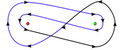
| + | {{math104-s21: | ||
| + | |||
| + | {{math104-s21: | ||
| + | |||
| + | If you find constructing local minimum too difficult, you can prove something weaker: there is a sequence of non-zero critical points of $f$ convergent to $0$, where a critical point of $f$ is a point $x$ with $f' | ||
| 4. (3 pt) Let $\varphi(x) = \min \{ |x - n| | n \in \Z \}$, then $\varphi(x)$ is a periodic continuous function, with a shape of saw-teeth. Plot $\varphi(x)$. We will use $\varphi(x)$ to construct a continuous and nowhere differentiable function. Prove that (**updated version, replaced $2^n$ by $4^n$**) | 4. (3 pt) Let $\varphi(x) = \min \{ |x - n| | n \in \Z \}$, then $\varphi(x)$ is a periodic continuous function, with a shape of saw-teeth. Plot $\varphi(x)$. We will use $\varphi(x)$ to construct a continuous and nowhere differentiable function. Prove that (**updated version, replaced $2^n$ by $4^n$**) | ||
| Line 14: | Line 20: | ||
| is such a function. | is such a function. | ||
| - | Hint: Let $\varphi_n(x) = 4^{-n} \varphi(4^n x)$. For each point $a \in \R$ and each positive integer $n$, show that we have $h_n = 4^{-n-1}$ or $h_n=-4^{-n-1}$ such that that $|\varphi_n(x + h_n) - \varphi_n(x)| = |h_n|$. Then show that, for any integer $m > n$, then $\varphi_m(x+h_n) = \varphi_m(x)$, | + | Hint: Let $\varphi_n(x) = 4^{-n} \varphi(4^n x)$. For each point $x \in \R$ and each positive integer $n$, show that we have $h_n = 4^{-n-1}$ or $h_n=-4^{-n-1}$ such that that $|\varphi_n(x + h_n) - \varphi_n(x)| = |h_n|$. Then show that, for any integer $m > n$, then $\varphi_m(x+h_n) = \varphi_m(x)$, |
| Extra question (you are free to take a guess. This question has no points). Let $f(x)$ be a differentiable function on $[-1,1]$ with $f' | Extra question (you are free to take a guess. This question has no points). Let $f(x)$ be a differentiable function on $[-1,1]$ with $f' | ||
math104-s21/hw10.1618378049.txt.gz · Last modified: 2021/04/13 22:27 by pzhou
Page Tools
Except where otherwise noted, content on this wiki is licensed under the following license: CC Attribution-Share Alike 4.0 International


