math121b:03-20
Differences
This shows you the differences between two versions of the page.
| Both sides previous revision Previous revision Next revision | Previous revision | ||
|
math121b:03-20 [2020/03/19 23:27] pzhou |
math121b:03-20 [2020/03/19 23:42] (current) pzhou |
||
|---|---|---|---|
| Line 18: | Line 18: | ||
| And to leading order, we can replace $f(z)$ by its value at the critical point. | And to leading order, we can replace $f(z)$ by its value at the critical point. | ||
| + | |||
| + | ** Example ** | ||
| + | Physicists ususally use $1/\hbar$ as $\lambda$. Here are some sample computation. | ||
| + | $$ \int_\R e^{-\frac{1}{\hbar} x^2/2} dx = \sqrt{2\pi \hbar} $$ | ||
| + | $$ \int_\R x e^{-\frac{1}{\hbar} x^2/2} dx = 0 $$ | ||
| + | $$ \int_\R x^2 e^{-\frac{1}{\hbar} x^2/2} dx = \hbar^{3/2} \int_\R u^2 e^{- u^2/2} du = \hbar^{3/2} \sqrt{2\pi} $$ | ||
| + | The point is that, having $x^2$ in the pre-factor will make the integral much smaller (indeed, the $x^2$ factor is killing the peak of $e^{-x^2/ | ||
| + | |||
| + | Another trick to compute the last equality is that | ||
| + | $$ \int_\R x^2 e^{- \lambda x^2/2} dx = -2 \frac{d}{d\lambda} \int_\R | ||
| + | |||
| ---- | ---- | ||
| Line 50: | Line 61: | ||
| where the last step uses trig identity $\sin(A) = \cos(\pi/2 - A)$, so that we agree with Boas. | where the last step uses trig identity $\sin(A) = \cos(\pi/2 - A)$, so that we agree with Boas. | ||
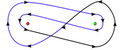
| + | Here is a picture of the 'ideal contour', | ||
| + | {{ : | ||
| + | It is made with [[https:// | ||
| + | |||
| + | |||
| + | |||
| + | ------ | ||
| - | Here is a [[https:// | + | This finishes Chapter 12. I did not talk about the Airy function, Hermite function, Laguerre functions. I will leave those |
| - | {{ : | + | as reading materials, and post homework questions about them. |
math121b/03-20.1584685678.txt.gz · Last modified: 2020/03/19 23:27 by pzhou
Page Tools
Except where otherwise noted, content on this wiki is licensed under the following license: CC Attribution-Share Alike 4.0 International


