
Table of Contents
- Preface
- Introduction
- Fiestas Patronales — 1, 2, 3 March 2024
- Carrera Noctura Rincón de Soto — 9 March 2024
- Calahorra to Zaragoza en bicicleta — 15, 16 March 2024
- Olite Castle – Palacio Real de Olite – Erriberriko Errege Jauregiko — 17 March 2024
- San Millán de la Cogolla and the Glosas Emilianenses — 22 March 2024
- Mercaforvm — 23 March 2024
- Paso Vivente — 28 March 2024
- Pilatos — 29 March 2024
- Conclusion
- References
Preface
I began writing this blog post in April after a series of particularly eventful weeks that began in March. Due to a combination of life, procrastination, and perfectionism, it took me until August to finish. When I began writing, I had two audiences in mind. The first was my friends and family. For those who would be interested, I wanted to share what I had been up to in Spain, and I wanted to do it in a format other than the typical social media post. A personal blog feels like a return to a different era of the internet. It also feels like an act of resistance against modern social media platforms that profit by inflaming emotions and enfeebling attention spans.
The second audience for this blog post was me. My time in Spain has been filled with once-in-a-lifetime experiences and has been a deeply meaningful new chapter of my life. Yet, many of these seemingly unforgettable experiences have come and gone leaving only memories as evidence for their existence. And memory is no guarantee. Experience can only ever exist in a moment, but you can try to freeze some of it in time by writing it down. Writing in the form of a blog post has required me to organize my thoughts and memories in a more coherent format than my typical stream-of-consciousness journal entries. A blog also has the advantage of augmenting storytelling through pictures and videos. My hope is that this blog post will serve as a time capsule that, when opened, will let me re-live and reflect on the memories it contains.
Introduction
Shortly after moving to Calahorra in October of 2023, I began to proudly proclaim “There’s always something going on here.” That couldn’t have been more true in March of 2024. The month began with three days of local city festivities, followed up with an ancient Roman market, and ended with a week of Easter celebrations. Between these local events and my work as a language assistant, I managed to participate in a local 10k race, complete an overnight bike trip, visit a castle, and visit two of the oldest monasteries in Spain. In what follows, I’ve tried to create a chronological series of vignettes describing these experiences as I remember them.
Fiestas Patronales — 1, 2, 3 March 2024
Many cities and towns in Spain have patron saints. The patron saints of Calahorra are San Celedonio and San Emeterio. According to legend, these two brothers and Roman soldiers were martyred by decapitation at the bank of the Cidacos River after refusing to renounce their faith in Christ. Nearly 1700 years later, thanks to their sacrifice, the residents of Calahorra enjoy an extended period of partying twice a year called fiestas patronales. I was lucky enough to be present for the March celebrations this year and here I’ve recounted a few of the highlights.
Peñas, Pañuelos, Charangas, and Zurracapote
Key to fiestas patronales are the peñas, which are sort of like social clubs or rally committees. In Calahorra, there are six peñas: El Sol, Calagurritana, Philips, El Hambre, La Moza, and La Riojana. Each peña has its own headquarters, colors, and marching band called a charanga. During fiestas patronales, members of a peña will wear a colored bandana around their neck called a pañuelo to signal their membership in a particular peña. With peña El Sol, for example, the members wear all white with dark green pañuelos. The peñas help organize fiestas and are at the center of the opening ceremony. To commence fiestas, one representative from each peña climbs the statue of Marcus Fabius Quintilliano that stands in front of the town hall and ties one of the peñas’ colored pañuelos around the statue’s neck. This done, the members of each peña collectively march up the main street and back to their headquarters, accompanied by the music from their respective charangas (marching bands). My friends and I, after watching the opening ceremony and the parade of peñas, followed peña El Sol back to their headquarters for the first public degustación of the fiestas.
A degustación is a dish or drink that a peña will prepare for members of the public, usually to be consumed at their headquarters. Degustaciones are offered multiple times during fiestas but the first degustación is always the degustación de zurracapote. Zurracapote is an alcoholic drink made from a mix of wine, peach, and cinnamon, and is served from a spouted glass decanter called a porrón whose form may remind some of a bong. After following El Sol back to their headquarters and meeting our local friends there, my friends and I were given a quick lesson on drinking from a porrón. Drinking from one is kind of how I would imagine drinking wine from a small watering can would be. You lift the porrón up high and tip the spout towards you, creating a small torrent of wine that ideally lands in your mouth. Someone told me later that the way to look like you know what you’re doing is to hold the porrón as far away from you as possible to create the longest possible torrent of wine. After taking a swig, you pass the porrón to the next thirsty-looking person.
In the days leading up to the fiestas, several locals had warned me about the zurracapote. “Careful with that stuff; don’t drink too much of it,” was the gist of their advice. I understood why after my first taste. Zurracapote is mainly sweet, as you would expect from a drink made with peaches and cinnamon, but it’s the vibe that made me want to keep drinking. Here I was in Spain, drinking wine out of a glass watering can with my new friends, some of them language assistants, some of them locals and their families, the city alive with social energy. After the zurracapote, we walked over to peña Calagurritana which would become the last stop of my night. I’ll admit that the memory of how we got from peña El Sol to peña Calagurritana is a bit fuzzy.


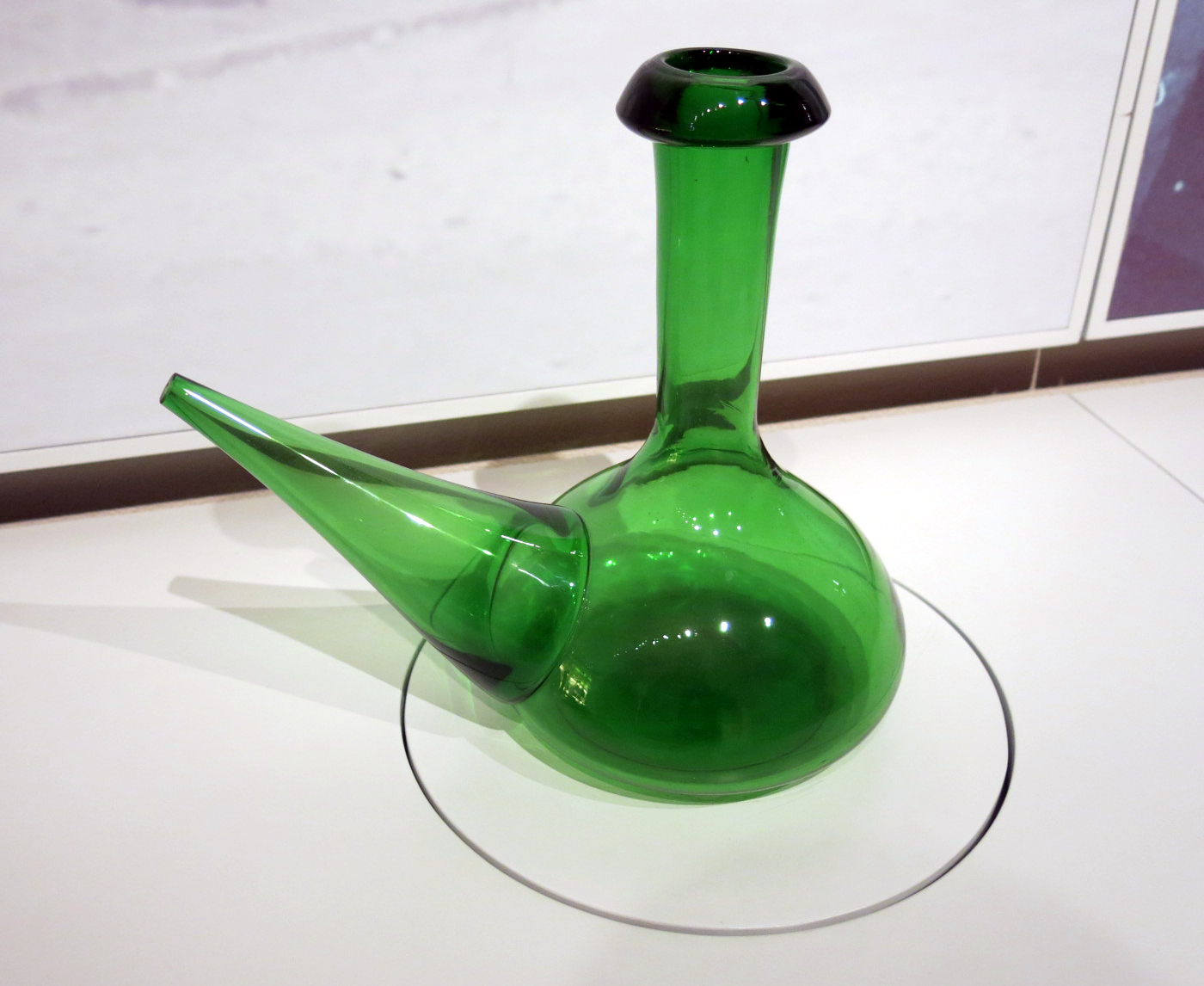
Enfo, CC BY-SA 3.0 https://creativecommons.org/licenses/by-sa/3.0, via Wikimedia Commons
The Encierro
The running of the bulls through the streets of Pamplona during the annual San Fermín festivals is an image that comes to mind for many when they think of Spain. I was surprised to learn that this kind of activity, called an encierro, happens in villages throughout Spain, including in Calahorra. During the March fiestas, two encierros were programmed in Calahorra: one for Saturday morning and one for Saturday evening, respectively. The word “encierro” means “enclosure,” and this makes sense when you see one. In Calahorra, heavy wooden fences were used to enclose a section of street about 300 meters long, creating a corridor terminating at the entrance to the plaza de toros, the bullfighting arena. The general idea of an encierro seems to be to release bulls into this enclosed corridor and to make them run from one end to the other for the amusement of the public.
The evening encierro was canceled due to bad weather but I was able to attend the one that took place Saturday morning. In fact, I did more than attend. The night before the encierro, I learned that practically any adult is allowed to hop the wooden barrier and enter the encierro to run with the bulls. I was told that as long as you’re over 18 and sober, you’re good to go. “Insanity,” was my first thought. But then, from somewhere deep in my psyche, another thought began to surface. “Hey, I run.” The urge to perform some unclear notion of masculinity manifested. “I could probably do that.” After voicing this thought, I was emboldened by a teacher friend’s comments that the bulls in Saturday’s encierro would actually be vacas (cows) and not real bulls like you’d see in Pamplona. “Surely this woman would never encourage me to do this if there were any real risk of danger,” I thought, reassured.
Such is my explanation for why, on Saturday morning, I showed up to the encierro wearing 2.5-inch inseam running shorts, Brooks running shoes, a windbreaker, and the red pañuelo that a friend had given me to wear for fiestas. Not exactly the traditional white pants and shirt worn by the other young men who, at the time of my arrival, were climbing over the wooden barrier to enter and exit the encierro at will without a word of objection from anyone. At this point, I still couldn’t visualize what would actually happen in an encierro. I wanted to watch a wave of vacas run by before deciding if I would risk running or not.
The first wave of vacas ran past at an alarmingly fast rate, so fast that my thought from the previous night changed from “I could probably do that” to “I could probably die doing that.” These may have just been cows, but they were big, fast, and they had horns. I didn’t even know cows could have horns. After watching a few more waves run by, however, I began to understand the strategy. The idea was to enter the enclosure, wait for the cows to get as close as you wanted, sprint a stretch of about 50 meters, then jump back over the barrier. I figured that with enough of a head start I would be safe. After some mental back and forth, I finally decided to take the risk and climbed over the barrier. As fate would have it, I was too late. The last vacas had already been run back into the bullfighting arena and I would not have my chance to perform some vague and probably toxic conception of masculinity. I climbed back over the barrier and out of the enclosure. All that was left to do was to take a seat in the bleachers of the bullfighting arena and watch part two of the encierro.
Sometimes an encierro ends with a bullfight and one or more dead bulls. Part two of the Calahorra encierro was not the type of bullfight where they kill the bulls. Instead, my friends and I watched from the bleachers as two professional performers taunted, sidestepped, and jumped over bulls that were released into the arena. There was a moment where a bull knocked over one of the performers and had him pinned to the ground. At that moment, perhaps for the first time in my life, I thought I was about to see someone die. Luckily, the performer got out from underneath the bull and walked off his injury, but this moment wouldn’t even be the wildest thing we’d see.
After the professionals left the ring came the first moment that I still can only describe to my friends in a flurry of hand gestures and with a tone of disbelief. A new bull was released into the ring and this time anyone from the audience was allowed to hop into the ring to contend with it. Anyone. So long as you looked over 18 and looked sober, no one was going to stop you. I watched incredulously as scores of young men jumped into and out of the ring while taunting the frustrated bull trapped there. The bulls that passed through the ring over the next half hour managed to knock several of these aspiring toreros to the ground and toss them about, though as in the case of the professionals, no one was seriously injured. In another moment of high excitement, one of the bulls jumped over the barrier that separated the arena from the dugout where the young bullfighters waited. Several moments of delightful chaos ensued before the bull was eventually returned to the ring. Though I am glad no one was seriously injured, I admit to having felt a twinge of satisfaction watching these bulls knock over the brazen men taunting them.
A total of three separate bulls were released for this round of public participation, after which came the last moment that still makes me throw my hands up in disbelief. The last bull having left the ring, a smaller juvenile bull was released so that the children in the audience could enter the ring and try their hand at bullfighting. Why not? The average age of the children in the ring seemed to be about twelve years old. Parents were present and the juvenile bull didn’t appear to pose a major threat to the kids, but that didn’t make it seem any less strange to me. It was at this point that I decided I was ready to head home for an early lunch.
I’m told there’s a stereotype the British have of the Spanish that says there are no health or safety regulations whatsoever in Spain. I think I see where that comes from.
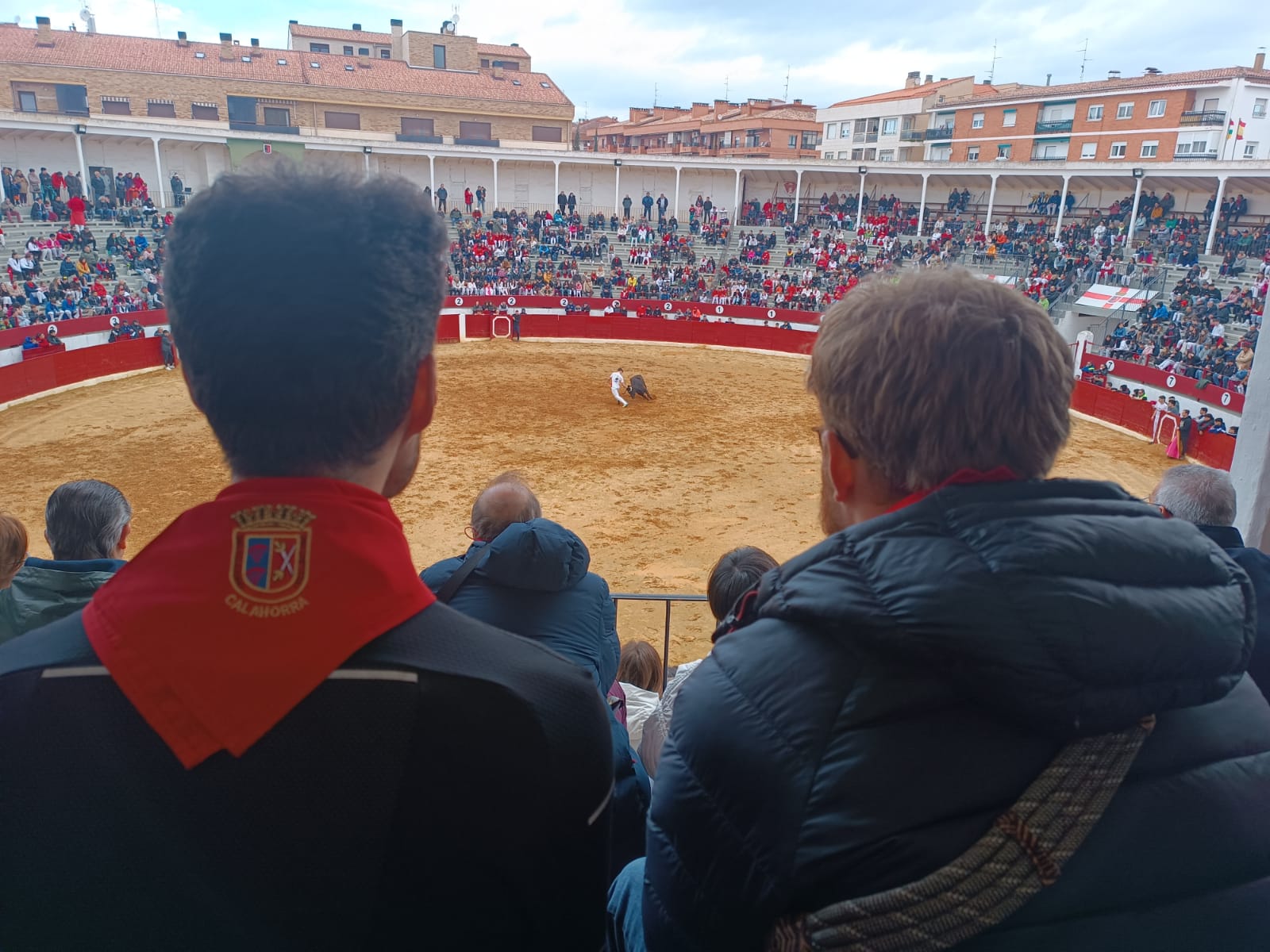
Los Gigantes – The Giants

These giants moved around town during fiestas. I’m not sure who all the giants are supposed to be but they seem to represent important characters in the history of Spain and Calahorra. They were arranged chronologically with the oldest historical character in front. I could identify Marcus Fabius Quntilliano as the giant at the front of the line and directly behind him is La Matrona. The two giants at the back of the line are probably Ferdinand and Isabel, the Catholic Monarchs.
The Fireworks
I’m including a few words about the different fireworks displays that took place during fiestas because of how different they seemed from those I’ve experienced in the United States. Firecrackers in the United States feel pretty regulated. Fireworks you can legally buy don’t get too explosive. The professional fireworks displays I’ve attended have always required the crowd to be far away from the explosions, at least a few hundred feet. Not so in Calahorra.
In the first display I attended, I watched as the roundabout in front of the town hall exploded in a violent sequence of thundering sound and billowing smoke. This must be what a warzone is like, I thought. The explosions were so loud and rapid at the show’s conclusion that I was sure there was some kind of pyrotechnic malfunction. Nope, it was just the programmed finale. When the smoke cleared, I was surprised to see that the roundabout’s garden, fountain, and statue were still standing, despite the bombardment I had just witnessed.
I attended another show that evening, also in front of the town hall. This time my surprise was due to our permitted proximity to the show, which was about 50 meters from where mortars were rocketing into the air. As they exploded at nearly building-level overhead, I had to cover my open cup of beer to prevent little chunks of burnt paper from landing in my drink. I certainly had never experienced this in the US.
Maybe this type of edgy fireworks display does happen in the US and I just need to get out more. But something about watching the borderline pyrotechnic shelling of an unconcerned Calahorra public still leaves me perplexed.
The Puppet Show – Gogorito
At the end of fiestas, my language assistant friends and I attended a children’s puppet show called Gorgorito. Our teacher friend told us that the show is a tradition during fiestas. She had attended the show as a young girl with her parents and had continued the tradition by bringing her own daughter to see it. Two characters are always present: the 7-year-old boy protagonist named Gorgorito and the evil witch called La Bruja Ciriaca. Each year, Gorogrito must stop Ciriaca’s evil plans. While the details of the plot change each year, our teacher friend explained to us that the show’s ending is always the same. The show always ends with Gorgorito repeatedly smacking Ciriaca with a wooden paddle. Imagine it: generations of Spaniards connected by the shared experience of watching a puppet child relentlessly beat down an evil puppet witch. It isn’t any worse than the stylized cartoon violence that you’d see in an episode of Tom and Jerry, but I still find the whole concept quaint and amusing.
The performance we attended was in a gymnasium. A crowd of children sat gathered in front of an elevated puppet-show stage while their parents sat behind them in the gym’s bleachers. The plot of this edition of Gorgorito had something to do with Ciriaca and one of her evil accomplices kidnapping an innocent dog. With the help of the children in the audience shouting out hints, Gorgorito managed to rescue the dog and beat down both Ciriaca and her evil accomplice. I remember being particularly amused by the hollow “thwack!” Gorgorito’s paddle made as it connected with the villain’s faces. I hope the tradition continues.
Entierro de la cuba and conclusion
The event that marks the close of fiestas is the entierro de la cuba, “the burial of the wine barrel.” The peñas march from their headquarters to the town hall, the inverse of the march they perform at the beginning of fiestas. At the front of the parade is a prop wine barrel, the cuba, that the peñas carry on a small funeral bier. Like at the beginning, the peñas march accompanied by their members and the music from their charrangas, but this time their members also carry prop candles, the kind you would see at a vigil. As the peñas march, they lament that the last drop of wine has gone from the barrel and now the party must end. I didn’t see it, but I assume a mock burial is performed for the empty wine barrel once the parade reaches the town hall. What I do know for certain is that, once all the peñas are assembled in front of the town hall, members remove their peña’s pañuelo from the statue of Quintillano’s neck. With the cuba buried and the pañuelos removed, fiestas patronales have ended. The end may be solemn, but there’s no need to lament the burial of the barrel. Come August, the peñas will take to the street again for the year’s second edition of fiestas patronales and the zurracapote will flow once more.
Carrera Noctura Rincón de Soto — 9 March 2024
Rincón de Soto is the village that neighbors Aldeanueva de Ebro, the town where I was a language assistant this year. Rincón has a population of about 4000, making it slightly larger than Aldea, and is famous for its cultivation of high quality pears. A language-assistant friend and I heard that there was a 10k evening race scheduled for Saturday in Rincón and we decided to sign up. My friend was a serious runner in high school and university, and since I had also run cross country in high school, we had gone on a few runs together around Calahorra. We hadn’t been training for racing but we decided it would be fun to participate in a local race.
We caught a ride to Rincón with the husband of a teacher I knew who generously offered to drive us. Even though my friend and I had run races before, we weren’t sure what to expect at a race in a small Spanish town. We were surprised. The vibes were immaculate. Even though Rincón is a small town, its center was packed. When we arrived, kids in the junior race were just starting to cross the finish line amidst blaring upbeat music and the cheers of their parents. A glance around revealed that runners from all the nearby villages were in attendance. Our driver pointed out the local legends and explained who was the favorite to win this year’s race. My friend and I were not expecting the vibe to be this positive nor for so much talent to be present. We were shocked to learn that the record for this 10k was 30:15. Runners will understand: that’s extremely fast. People were here to win. Not me though. My idea for this race was to make an effort but to not stress myself out. After a very last-minute warmup, my friend and I took our places at the starting line.
I never heard a gun go off, people just started running. I wanted to try to stick with my friend for the first few hundred meters but he quickly vanished into the front of the pack. The race course took us all over the little town of Rincón de Soto. Families were leaning out of their windows and crowding their balconies as we ran past, blasting upbeat music and shouting words of encouragement. I appreciated the encouragement because I was suffering. Even without pushing myself to my limit, the race was extremely challenging for me. This is the thing about running: if you’re trying, it hurts. It doesn’t matter if you’re in the lead or you’re dead last, as long as you’re pushing yourself a little bit, you’re going to suffer. After what seemed like an unending 41 minutes and 46 seconds, I crossed the finish line. I stumbled through the crowd for a few moments before locating my friend. I asked about his time. “My watch says 33 minutes and 51 seconds.” I think I probably yelled. I knew he was fast, but now I really understood. We would later learn that I finished in 94th place out of 343 runners. My friend finished 8th.
I’m of the opinion that the best part of a race is what happens after it’s over. My friend and I reunited with our driver who was equally impressed with my friend’s incredible finish. We stayed around a few minutes to soak in the energy and meet some of our driver’s friends before heading back to Calahorra. Our participation earned us a few social connections. My friend and I met up for pintxos shortly after the race and were recognized by a few Calahorra runners who had also participated. It felt good to get recognized by locals in one of our favorite bars. Word of my friend’s finish even spread as far as the carpool that took me to Aldeanueva three times per week. “They’re saying an extranjero ran a fast race in Rincón.” “Oh yeah, that’s my friend who works at the adult language school. Él es un crack.”
Participating in this race was an excellent decision. I got a taste for racing outside of high school cross country, I made some new connections, and I even got some of Rincón de Sotos’s famous pears in my bolsa de corredor (runner’s bag). I wouldn’t have guessed it before running, but I was now looking forward to the other upcoming races near Calahorra.
Calahorra to Zaragoza en bicicleta — 15, 16 March 2024
I used the third weekend in March for my first ever solo overnight bike trip. It was an adventure and deserves its own write-up, so for now I’ll stick to what I deem the key points.
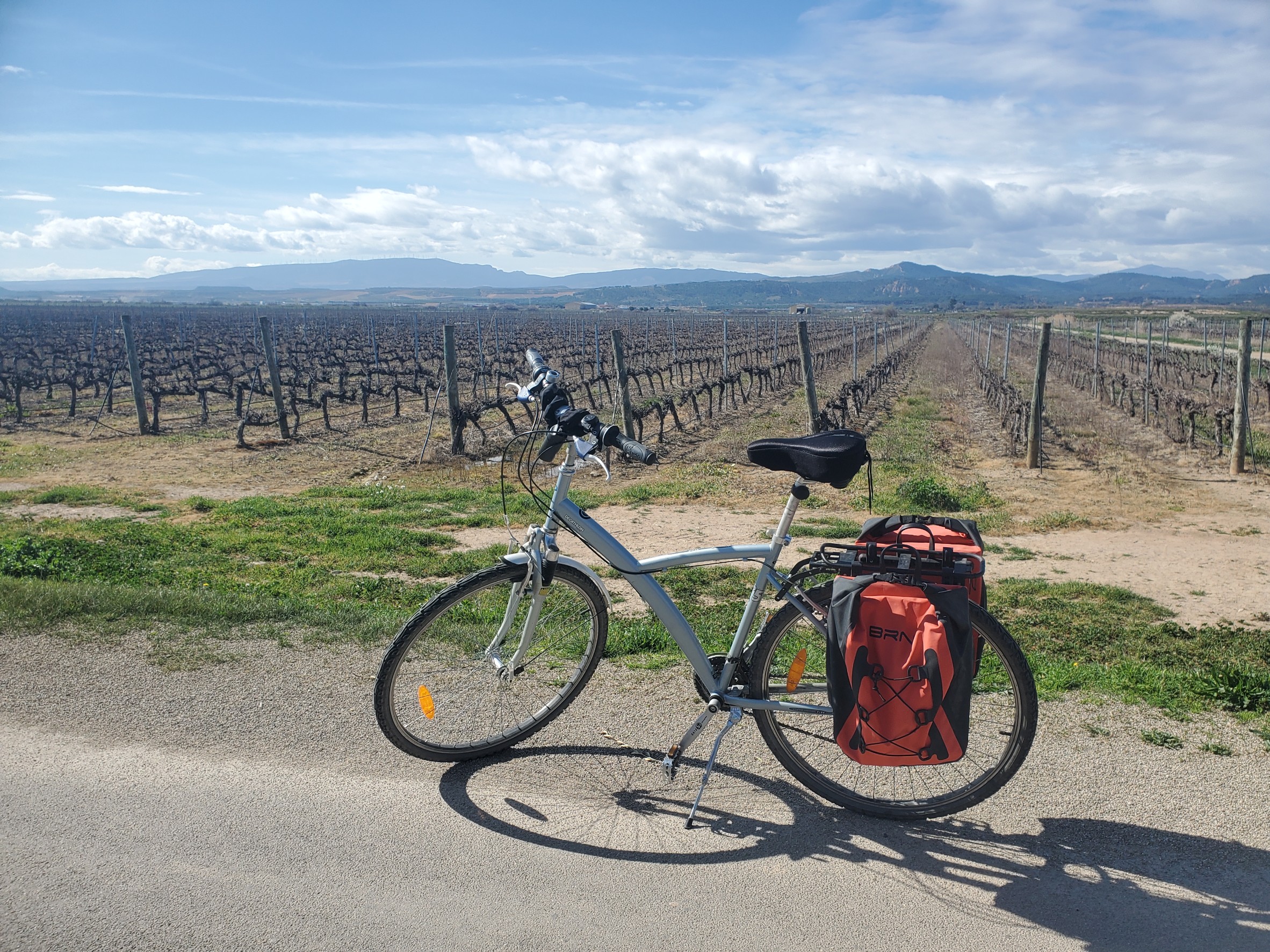
Bikes and bike travel have been a growing obsession of mine over the past two years, so I bought a bike my first week living in Spain. Bike travel has proved to be one of the best ways to explore Spain and La Rioja. Hopping on your bike and riding out into the Rioja countryside is like riding your horse in the fantasy of an old western film. After savoring a beautiful landscape from the (bike) saddle, you roll into some little town that you’ve never heard of that might have as few as 200 inhabitants. Don’t think it will be uninteresting for want of size though. You can always count on at least three things in a Spanish village: an ayuntamiento (town hall), a beautiful church that’s at least 300 years old, and a bar. Usually there will be more than that, like the ruins of some old castle, a beautiful geologic formation, a plaque explaining some esoteric thing that happened there centuries ago, or even dinosaur footprints (in some parts of La Rioja). Once you roll through town, you roll back into the landscape and on to the next village. Your bike is the metal steed that carries you through the ancient and charming Spanish countryside.
When I began to understand this reality, my head quickly filled with fantasies of long bike odysseys across the Iberian peninsula with nothing more than my wits, saddlebags, and GPS to accompany me. These fantasies remained unrealized until March, when I finally decided to take the plunge and planned a straightforward overnight bike trip. I would ride from Calahorra to Zaragoza and return by train. I would follow the Canal imperial de Aragón whose mostly level and somewhat paved surface would act as a kind of bike highway leading me to the Aragonese capital. The canal ran right through a town called Gallur that was conveniently located about halfway to my destination, making it an excellent place to stop for the night. It seemed like a simple and convenient plan, ideal for an introduction to multi-day bike touring.
Despite the simplicity and convenience of the route, I began to feel anxious after making the hotel and train reservations. I was confident I could physically complete the route, but the logistics made me nervous. Would they let me store my bike overnight in the hotel? What if there isn’t enough space on the train for my bike and I can’t get back from Zaragoza? These worries were enough to bring me one click away from canceling the trip several hours after I had reserved everything. At the last moment, I recovered my resolve and committed to the plan. I’m glad I did.
In short, the ride to Zaragoza was awesome. I rode about 90 kilometers the first day and 80 the second. It was a peaceful passage through La Rioja, Navarra, and Aragón, where I had the chance to comprehend the vast landscapes that surround Zaragoza. My logistical worries proved to be irrational. There was no problem storing my bike at the Gallur hotel, and when the train to Calahorra rolled into the station, there was plenty of space for my bike. It was time to savor the last part of the journey. I boarded the train, set my bike at the back of the car, then sat down in one of the cushioned seats a few rows in front of my bike.
During the return train ride, my new worry was that my bike would fall over if the train came to a sudden stop. I would turn around and look to the back of the car each time the train stopped to make sure the bike was still standing. When the train stopped in Alfaro, I looked back at my bike and didn’t understand why a man was beginning to roll it off the train. It took me a moment to understand what was happening. I didn’t know what to do. I jumped up from my seat and ran directly at him. He saw me, dropped the bike in the door of the train, and sprinted off. The conductor yelled something after him and the entire train car crowded the door to watch this man make his escape. It seemed to me the perfect moment to yell some choice insult, but the Spanish part of my mind came up blank. I sat next to my bike for the rest of the ride home after that. An odd finish to an otherwise positive journey.
I came away from this trip with more confidence and desire to undertake a longer one. I also felt that the bike was now imbued with some kind of special energy. Not only had it just carried me 170 kilometers to Zaragoza in two afternoons, but I had just rescued it from theft. I don’t really believe in portents, but if the universe were trying to tell me something, I think it would be that this bike and I still have more to accomplish.



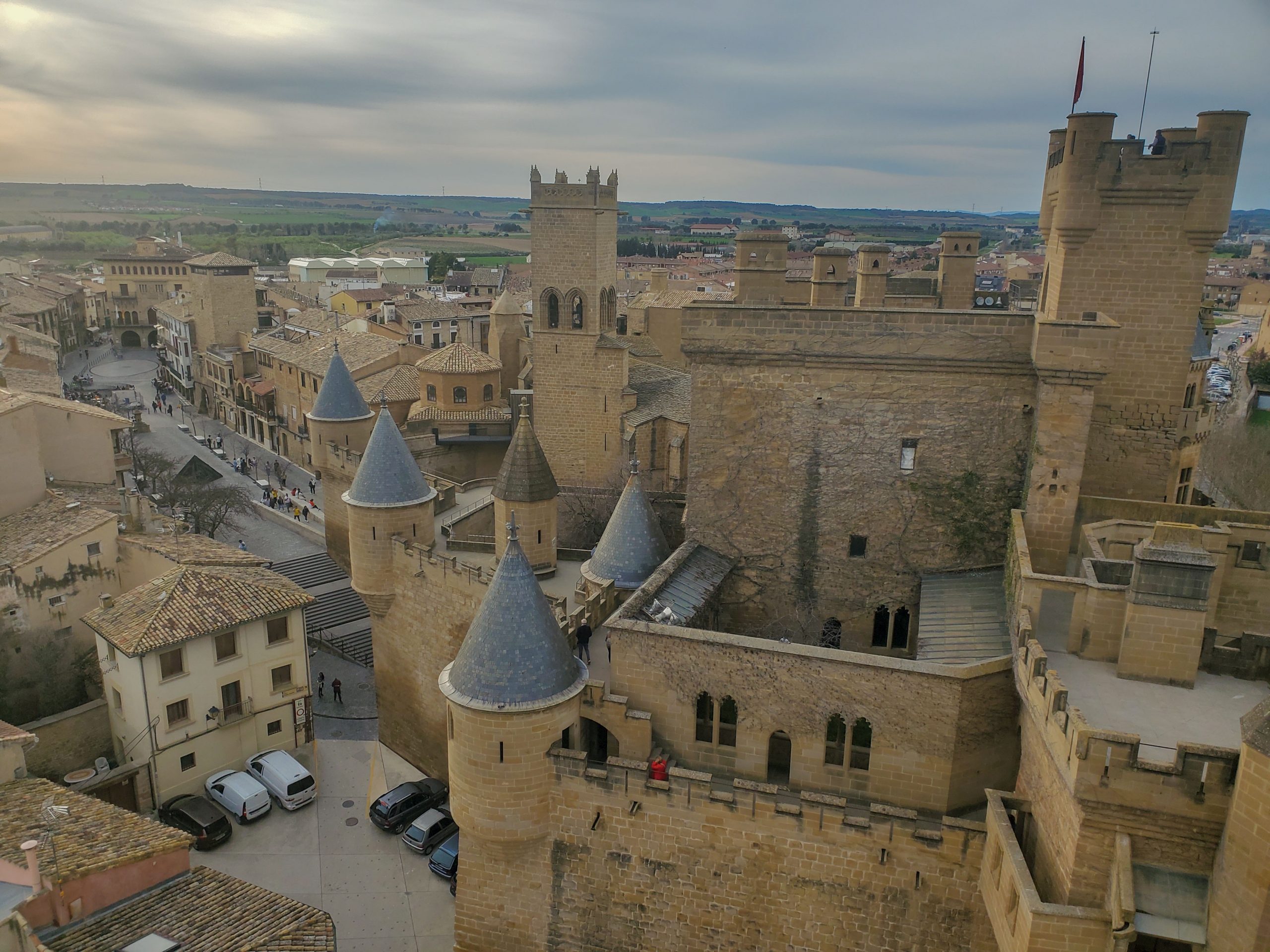
Olite Castle – Palacio Real de Olite – Erriberriko Errege Jauregiko — 17 March 2024
Olite is a small village about an hour’s drive to the north of Calahorra. It’s famous for its castle called El Palacio Real de Olite, the Olite Royal Palace. The castle’s foundations were built in the 13th century for the kings of Navarra and today it’s one of the most visited castles in Europe. Those in the know will even tell you that the palace is the inspiration for the Disney castle. A teacher friend generously invited my runner friend I to visit the castle with her and her family. We were happy to accept the offer.
Our friend and her family went even further in their generosity by booking a tour for us. The tour guide immediately clocked my friend and I as non-native Spanish speakers and seemed concerned that we may not be able to follow the content of the tour. “The tour is in Spanish and I’m going to talk fast, eh?” she warned. These comments used to bother me but I’ve learned to shrug them off. “She doesn’t know us. We’ll follow just fine,” I thought to myself. With the rest of the visitors gathered at the entrance to the castle, the guide began to speak. She wasn’t lying, she did talk fast. This was going to be one of those tours where I wouldn’t understand more than 50% of what was said. Something I did catch, however, was that the guide gave the introduction twice, once in Spanish (castellano) and again in Basque (euskera). Olite is in Navarra and therefore part of Euskal Herria, the land of the Basque people in Europe. I had only seen Basque on signs up to this point so it was fascinating to hear it spoken, even though I had no idea what was said. After this introduction, our group entered the castle.
The castle was fascinating, but my first impression was correct: I only caught about half of what our guide said. I understood enough, however, for me to notice that our guide seemed to speak of Navarra and the castle’s history with a particular air of pride and reverence. For instance, she took care to always refer to the capital of Navarra by its official name, Pamplona-Iruña, which includes the city’s Basque name. Our friend and her family also picked up on this. “How do you say ‘Pamplona’ without a ‘p’ sound?” her partner asked me later that day. I had no idea. “Iruña.”
The tour ended on the battlements and our friend’s daughter insisted we climb the castle’s six towers. As we climbed, her father tried to expand on the castle’s history for the benefit of my runner friend and I. “Dad! They don’t care about that! C’mon, we need to climb the towers!” He stopped talking after that. I felt some sympathy for him. “This poor man just wants to talk about a castle,” I thought to myself. We managed to climb all six towers just before the castle closed for the day. We took a stroll through Ollie’s medieval streets before driving back to Calahorra.
I was glad to check Olite off my list of places to visit. It’s a little difficult to get around without a car, so if not for the generosity of our teacher friend and her family, I don’t know that I would have made it this year. One more memory of Spain thanks to the generosity of others.


San Millán de la Cogolla and the Glosas Emilianenses — 22 March 2024
Ninguna otra lengua conocida, de extensión e importancia comparables a la española, puede ser atribuida y asociada a un monumento y entorno natural tan singularizado y concreto como San Millán.
—source; Spanish translation by me.
No other known language, of extension and importance comparable to Spanish, can be attributed to and associated with a monument and natural setting as singular and concrete as San Millán.
Near the end of the month, the government office that manages the La Rioja language assistants organized an excursion to the town of San Millán de la Cogolla, including a tour of the two monasteries there. I wasn’t expecting much but decided to sign myself up. In the end, the activity was one of my favorites that I did in La Rioja. Specifically, I was electrified by the history of the place. I’ll begin with my own retelling of the history of San Millán and then give the highlights from the tour of the monasteries.
The Holy Man, the Monasteries, and the Glosas
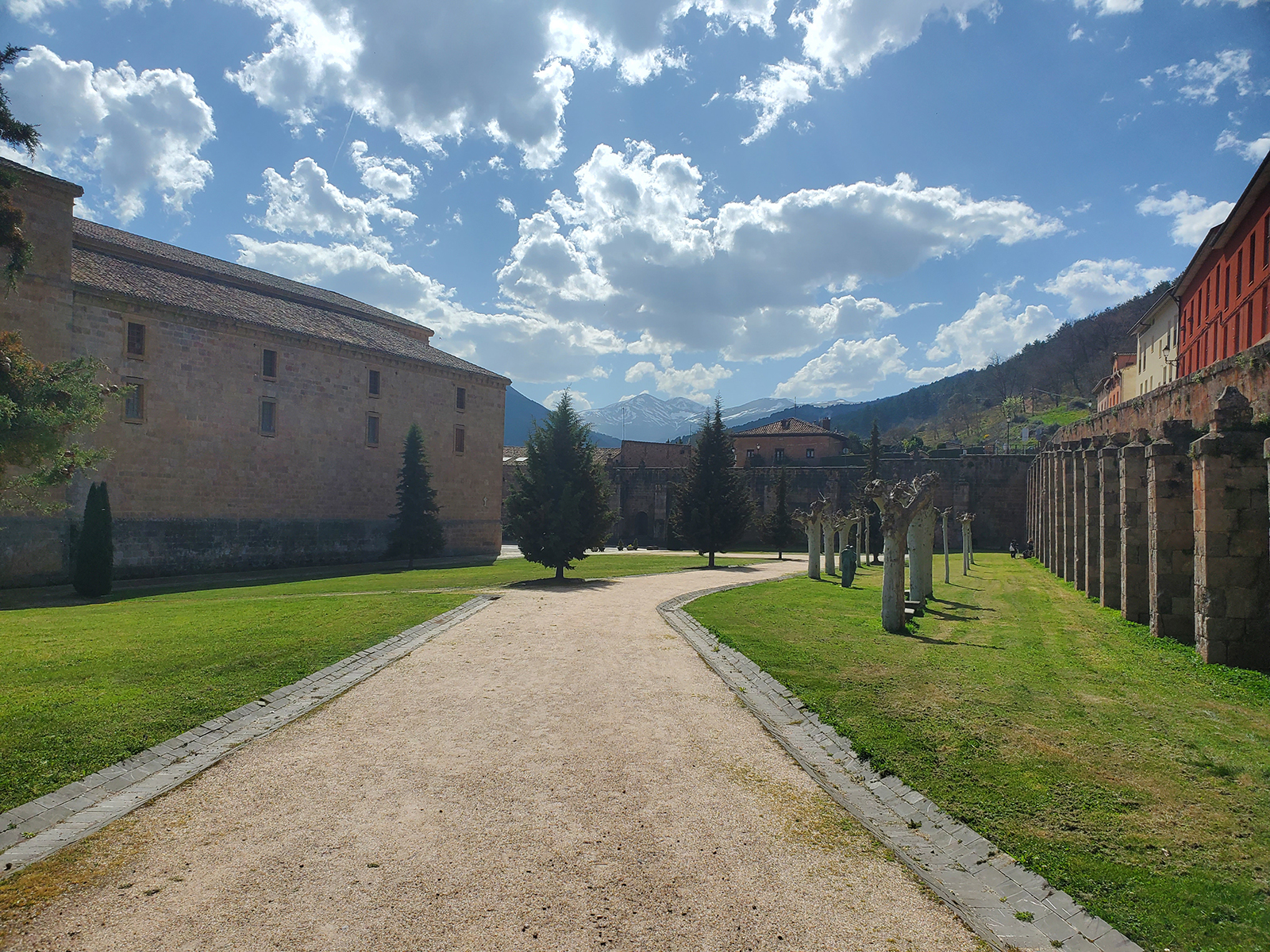
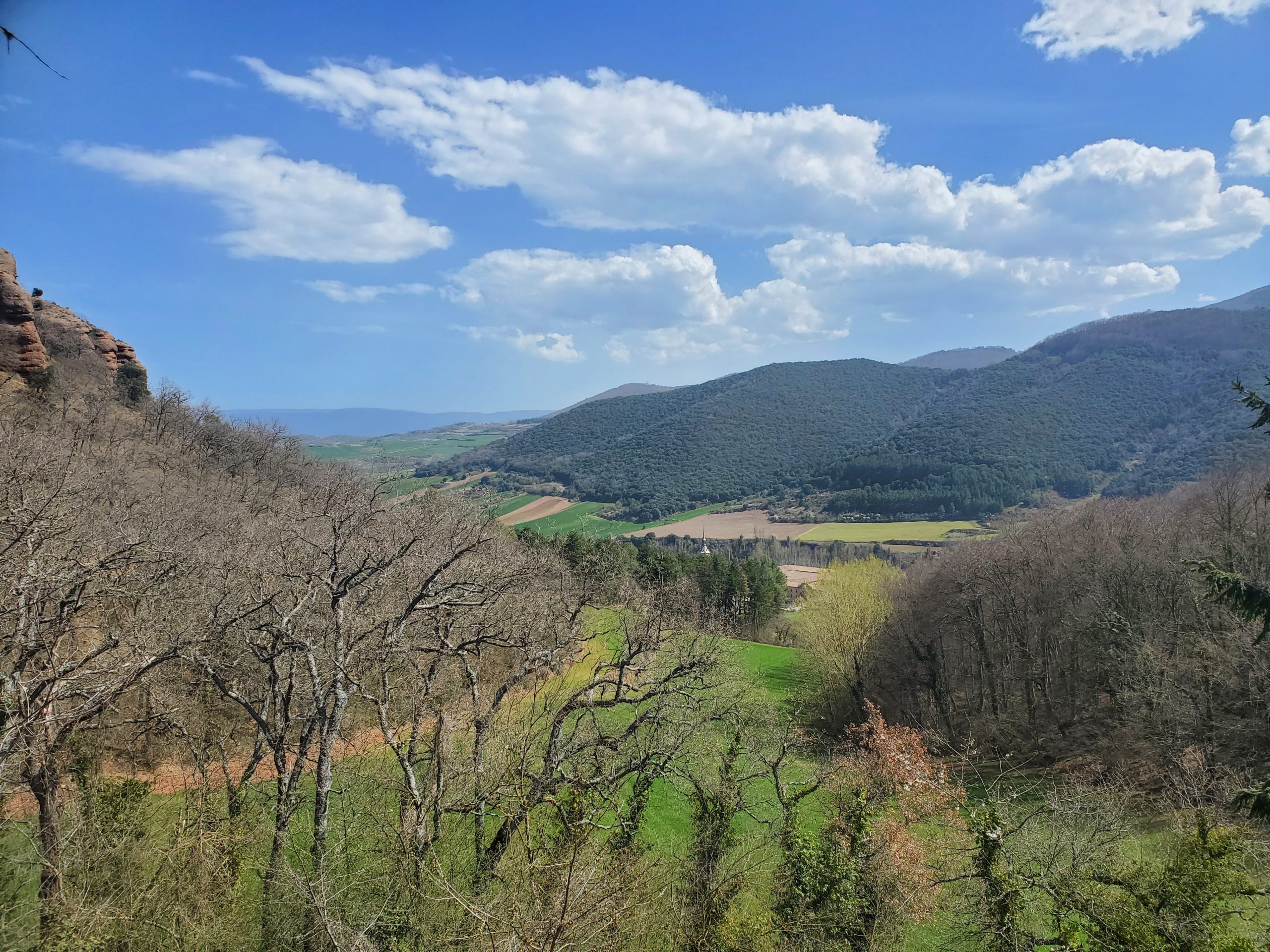
The town of San Millán de la Cogolla is a small village at the foot of the Sierra de la Demanda mountain range in the south of La Rioja. On the southern edge of the town’s territory is a small lush valley. There, in the shadow of the towering San Lorenzo peak, are nestled two ancient monasteries, Yuso and Suso. The story of these monasteries give the town of San Millán its status as an UNESCO World Heritage site.
In the 6th century CE, the holy man San Millán decides to dedicate his life to the study of the bible and the teachings of Christianity. Others before him have made the same decision, but he goes further. To live his life of devotion, he deems it necessary to live isolated from society. He chooses the small valley to the south of what is now the village of San Millán as the place where he will begin this new life, installing himself in the caves that overlook the valley. After his death, those inspired by his life and teachings decide to undertake their own lives of religious solitude, installing themselves in the very same caves where the holy man lived. Generations will do the same for hundreds of years to come, and monastic life in Spain is born. With the passing of time and generations, a structure is built up around the caves. It will become the site’s first monastery. Later, in the 11th century, a second monastery is built at the base of the valley. To distinguish it from the first, the later monastery is called Yuso (“below”) and the first one becomes known as Suso (“above”). For their testament to the introduction and tradition of monastic life in Spain, the monasteries Yuso and Suso are recognized as world heritage sites.
But it isn’t just for the origins of Spanish monastic life that Suso and Yuso are recognized as world heritage sites. As one might imagine, the monasteries accumulated centuries of documents over the course of their existence. In 1851, all documents deemed to be of historical interest are ordered removed from the monasteries and are delivered to the Royal Historical Academy in Madrid. The Academy publishes a catalog of the codices (manuscripts) removed from San Millán, noting that one codex, number 60, contains “some notes in the margin” (“algunas notas al margen”). It’s the story of these margin notes in Codex 60 that give San Millán its second recognition as a world heritage site.
Codex 60 is a collection of Latin sermons and other religious texts written on 90 pages of parchment, created between the 9th and 10th centuries. One who turns through its pages will note that on page 66 the main Latin script becomes sprinkled with words and symbols written in a smaller and thinner hand. This second script perches above individual Latin words, annotating them, and occasionally appears as a word or two in the margin of the manuscript. While the presence of this second annotating script is noted when Codex 60 first arrives in Madrid, the annotations go unstudied for more than 60 years. It’s not until 1913 that the full significance of the annotations is revealed. While working on his 1913 journal article “De Arqueología mozárable,” Manuel Gómez Moreno notices a particularly long annotation in the margin of page 72 in Codex 60. He looks closely, and makes the discovery. The annotation is a short prayer, only 44 words in his transcription. But the prayer isn’t written in Latin. It’s written in Spanish. Moreno dates the annotating script to the 10th century, making this annotation the oldest known evidence of the existence of the Spanish language.
Thirteen years later in 1926, Ramón Menéndez Pidal publishes a transcription of all the annotations appearing in Codex 60. The annotations are also written in the same early form of Spanish as the long margin note on page 72. Their purpose appears to be to help the reader understand the text. Some annotations translate words from the main Latin text, other annotations mark the grammatical structure of the Latin sentences. In Spanish, an explaining annotation in a text is called a glosa, and the early-Spanish annotations of Codex 60 are known as the Glosas Emilianenses. The Glosas remain the earliest evidence of the existence of the Spanish language, and are the second reason why San Millán is a world heritage site.
There is one more detail of this story that always seems to be included as an afterthought, though I find it equally thought-provoking. On pages 67 and 68 of Codex 60, the following glosas appear, respectively: “jzioqui dugu” and “guec ajutu ez dugu.” They are the only glosas in Codex 60 that are not written in Spanish nor in Latin. They’re written in Basque. Beyond their implications for Spanish, the Glosas are evidence for the contact of Spanish and Euskera (Basque) in the north of Spain more than a millennia ago.
The story of the Glosas is an electrifying synthesis of the mundane and the extraordinary. As a document, the intent and content of the Glosas is mundane. It isn’t the venerating chronicle of a tyrant’s rise to power, it isn’t a grand decree of law, nor is it an epic poem describing the life of a mythic hero. The Glosas are someone’s private notes, written with no intention in mind other than to help their author understand Latin. Put another way, the Glosas are someone’s 10th-century cheat sheet. And yet these humble notes are extraordinary. They are the oldest known evidence for the existence of a language that is now spoken across the world by half a billion people.
The synthesis of the mundane and extraordinary continues when we think of who might have been the Glosas’ author. During my tour of San Millán, I was told that the author of the Glosas was probably one monk who gave sermons in the adjacent village. He annotated the codex to help himself understand the Latin text, but also to help him explain the sermons to his audience in their spoken language. The two glosas in Basque suggest that the monk was also in contact with Basque-speaking people and was probably himself bilingual. To someone like me, the thought of a 10th century bilingual monk also able to read Latin is an extraordinary proposition. I grew up on the west coast of the United States in the 21st century. There, bilingualism is a coveted skill that seems like a recent phenomena. How could someone living in a cave in a mountain more than a thousand years ago speak two languages and read a third? The answer is that languages have always been in contact, now and throughout human history. Wherever languages meet, there are people who can speak both of them. For those people, bilingualism is not a coveted skill, but a necessary and mundane one. The Glosas remind us that multilingualism, while extraordinary, has always been a fact of the human experience.
I’ll close by explaining why I’ve chosen to dedicate so many words to this background on the Glosas. The study of a second language has enriched my life and has undoubtedly changed its course. In my studies, I’ve spent hours annotating texts, be it with translations or notes explaining difficult grammatical constructions. I find comfort knowing that, in a picturesque valley in the north of Spain more than 1000 years ago, there was someone doing the same. Across an ocean of time and a literal one, the author of the Glosas and I are connected in a small way.


Source: Real Academia de la Historia

Source: Real Academia de la Historia
The Workshop and Tour
I’ll return now to the 21st century and my personal experience at San Millán. When we arrived at the monasteries, the other language assistants and I were split into two groups. My group began by attending a workshop on medieval calligraphy. The workshop facilitator explained that monks would illuminate their hand-copied manuscripts by stylizing the first letter of the first word in important sections of the text. These letters would be large, colorful, and imaginative. A “T” might be drawn as a dagger, a “B” might be decorated with leaves, etc. Our task in the workshop was to create our own stylized letter using ink and a stylus of the type the monks would have used to create their manuscripts. I chose to create an “N” since I thought I could combine it with someone’s “O” to create “No,” the shortest statement I could think of. Our group moved on to the tour of Yuso after finishing our letters.
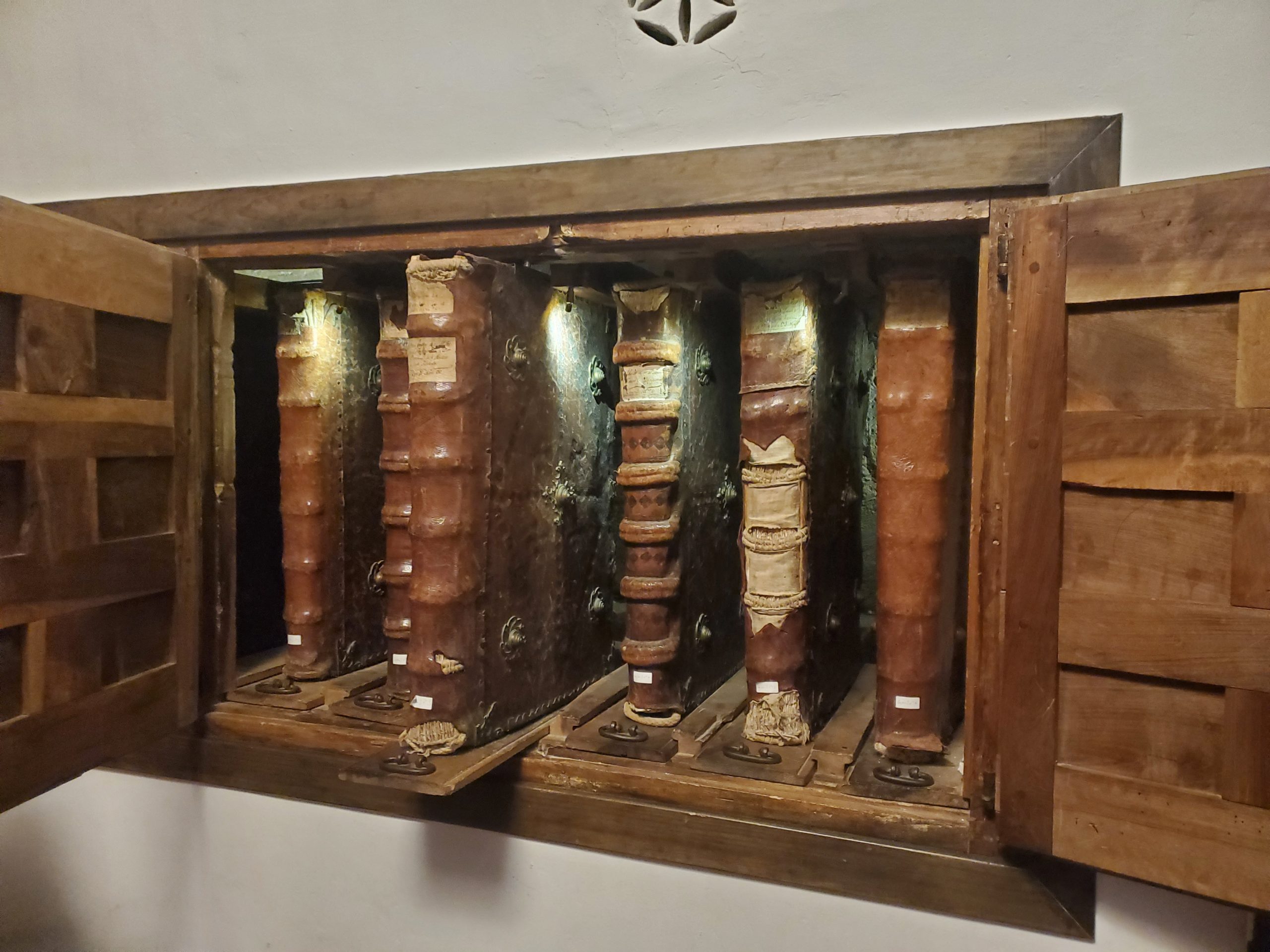
Yuso looks like the picture of a monastery. In March, the valley it sits in was lush with green, and San Lorenzo stood tall overhead, capped with snow. The monastery is an impressive stone building with an elaborate facade and tall entrance doors. We began our tour by passing through a walkway with a high gothic ceiling, looking out at the adjacent courtyard through the curves of a stone arcade. Our first stop was the monastery’s church. It was similar to many of the other beautiful churches I’ve visited in Spain, except for the massive painting of San Millán that hangs above the main altar. In the picture, Sán Millán is riding a unicorn into battle while wielding a sword of flame. After the church, we climbed the stairs to the second floor to see the canticles. These are huge books weighing about 70 kilograms each and made from the skin of many, many dead animals. Notated in enormous font on each of their pages are passages of gregorian chant to be sung by the monastery’s choir. The font is large so that, when the cantile is opened and placed in the choir, the singers at the back can see the text just as well as those in the front. The tour of Yuso ended shortly after seeing the canticles and we moved on to Suso.
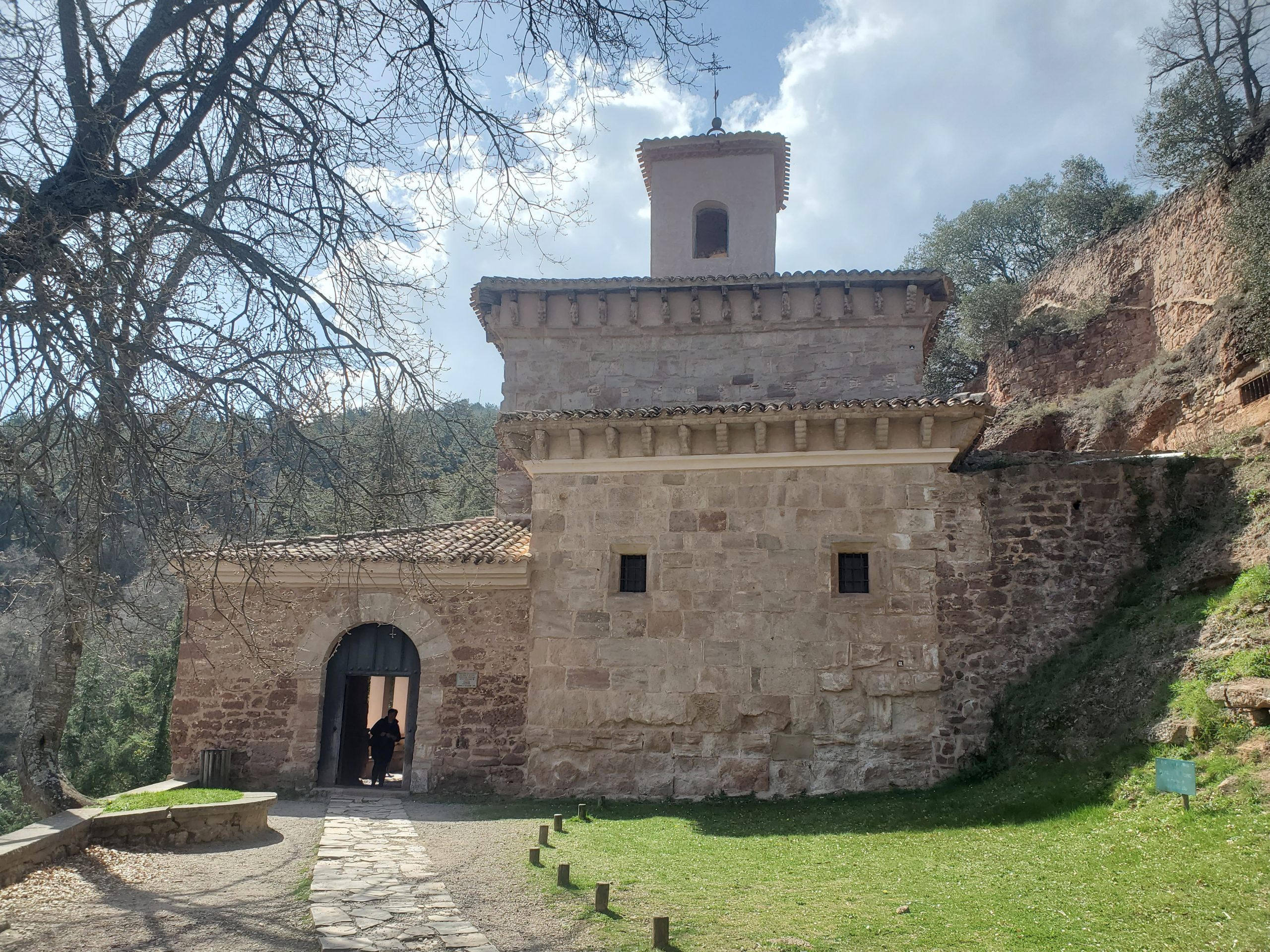
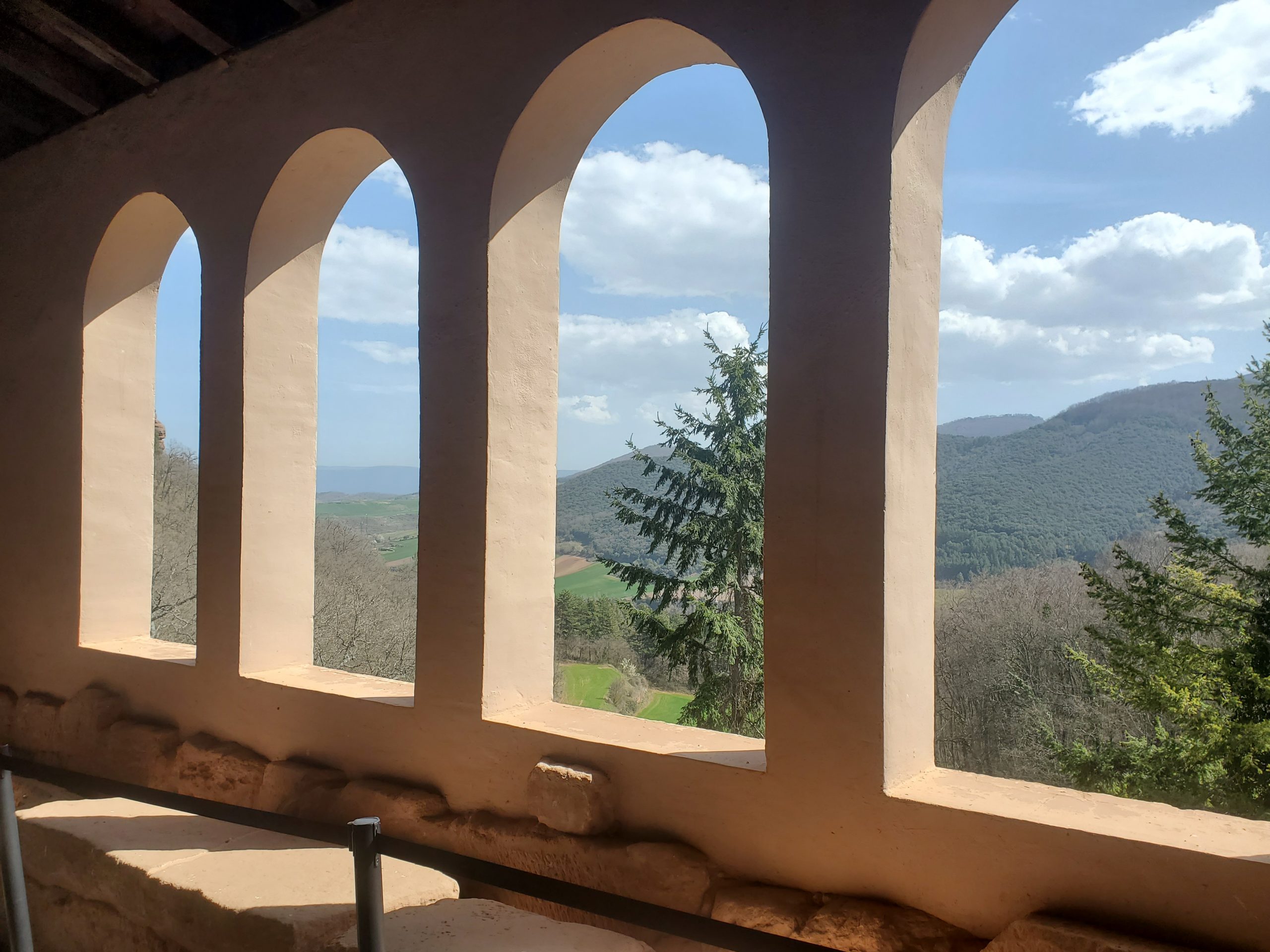
To get to Suso, we hopped on a bus that took us a short distance up the north side of the valley. The ride was beautiful. As we curved around the side of the valley, climbing higher and higher, the view below seemed to get greener and more beautiful. There, at the end of the bus ride, emerging from the valley wall, is Suso. It’s much smaller and humbler than its counterpart below, but in my opinion, much more interesting. Upon entering, we found ourselves in a small hallway with an arcade on the left. On the other side of the arches of the arcade was a spectacular view of the lush valley below. At the end of the hallway was the door to the main and only chamber of the monastery. We entered.
The first thing I noticed was the caves that form the main chamber’s back wall. The caves are a little eerie, and in one lies the cenotaph of San Millán. As our guide explained, a cenotaph (“cenotafio”) is a burial monument that contains no human remains. This one is a stone sarcophagus with the figure of San Millán carved into its cover. Carved into the perimeter of the sarcophagus are scenes depicting the miracles San Millán performed in his lifetime. Our guide went on to explain that the presence of the cenotaph made San Millán a site of pilgrimage for centuries. Pilgrims on the Camino de Santiago, then and now, could make a detour from the main route to see the cenotaph and pay their respects to Sán Millan the saint.
Besides the caves, my attention was drawn to the Islamic-style arches that are present in the monastery. In Spain, the fusion of Christian and Muslum art is called mozárable art, and the arches in Suso are examples of this fusion. When San Millán and his followers first began to inhabit the caves at Suso in the 6th century, Islam didn’t even exist. It’s a testament to the role of Islam in the history of the Iberian peninsula that in one of Spain’s oldest monasteries, and as far north as La Rioja, one can find Islam-inspired architecture.
After the tour of Suso, it was time to return to Logroño, and from there to Calahorra. I hadn’t expected much from this excursion, but in the end it was one of the most memorable things I did in La Rioja. The story of the Glosas left me enchanted. Humble Suso amazed me and I almost felt a temporal vertigo trying to comprehend the nearly fifteen centuries of history that had passed in that place. But in some sense, my experience at San Millán is almost typical for Spain. If there’s one thing I’ve learned here this year, it’s that this place is full of surprises wherever you look.
Gallery: San Millán de la Cogolla


Juan Rizi, CC BY-SA 4.0, via Wikimedia Commons


Mercaforvm — 23 March 2024
One of the most well-known annual events in Calahorra is Mercaforvm. Over a Saturday and Sunday in March, the street leading from the town hall to the Raso plaza is transformed into an ancient Roman market. The street is lined with stalls whose vendors sell artisan candies, breads, spirits, replica Roman weapons, and other trinkets. The market also opens with a schedule of performances that includes music, gladiator battles, dances, and bird shows. This affinity for ancient Rome comes from the fact that Calahorra was an important city in the north of Spain during the reign of the Roman empire. Calahorra makes its Roman past an important part of its contemporary identity.
Though it’s a big event in Calahorra, I only attended the Mercaforvm opening ceremony and spent about an hour afterwards exploring the market. The opening ceremony took place in front of the town hall where a stage had been erected. A tall man costumed as a Roman centurion took the stage and lifted his arm; from somewhere above the crowd, a raptor flew to the stage and landed on his outstretched gauntlet. Someone opened a scroll and began to read: the market had the blessing of the emperor and was to be open from Saturday until the end of the day Sunday. Following this declaration, a legion of locals dressed as Roman soldiers began to march around the rotunda of the ayuntamiento (town hall) and up the main street of the market. The market was now open.
Mercaforvm seems to attract lots of tourists to Calahorra and the market was packed with people. Though I enjoyed seeing the opening ceremony and exploring the market, the mass of people led me to spend most of that weekend away from the event. Maybe I would have had more fun if I were dressed in full centurion regalia.

Paso Vivente — 28 March 2024
On the Thursday before Easter each year in Calahorra, the local group “Paso Vivente” performs a live action Passion of the Christ. What I like about this performance is that it’s a moving one that takes place outside. The Valvanera promenade is set up with different stages where the group performs different scenes from the Passion. The performance begins with the Last Supper, then the audience follows the actors down the promenade as the scenes change and the story progrsses. The performance finishes at the end of the promenade with the Crucifixion and Resurrection.
While I enjoyed the performance, there’s something strange about watching an actor play Jesus be whipped, beaten, and crucified in live action, all while he’s wearing nothing but a loincloth. In the scene where Jesus is made to carry his cross, the actor actually dragged a full-size prop crucifix down the promenade while the audience watched from the sidelines. The moment where Jesus ascends to heaven was illuminated by colored stage lights, set to triumphant music, and accompanied by a cloud of smoke from a smoke machine. Like the encierro or the fireworks exploding directly over my head during Fiestas Patronales, I’m still not sure what to make of what I saw. For now, all I can say is that Paso Vivente left me entertained, amused, and bemused.
Pilatos — 29 March 2024
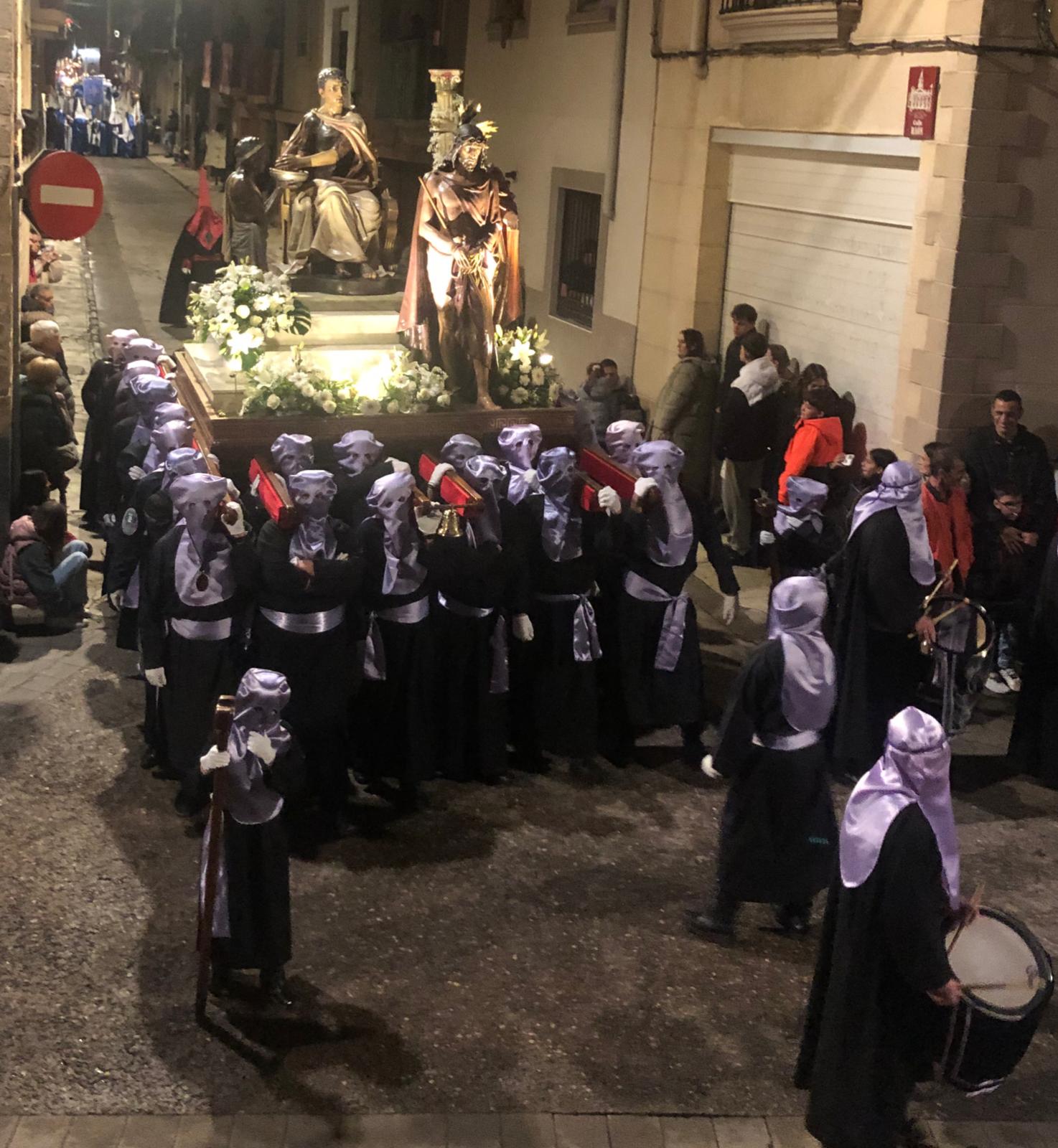
On the Friday of Semana Santa, the week leading up to Easter Sunday, I had the unexpected and remarkable experience of participating in a paso. Some may have heard of this tradition. It’s the one where people march through the streets while wearing costumes that an observer from the US could mistake for KKK regalia. A paso is a religious scene built on a wooden platform that is carried by a group of people during a procession, sort of like a float. During Semana Santa, the pasos are typically accompanied by marching drums and religious icons. In Calahorra, there are nearly 20 pasos that each depict an almost life-size scene from the Passion of the Christ. Each paso is accompanied by a separate group whose members all wear a hooded costume with colors specific to their paso. While it’s a bit spooky to watch a group of hooded figures process down a street in time with a primal drumbeat, I found the vibrance and variety of colors to be absolutely stunning.
Participating meant I actually got to wear one of those colorful costumes. The opportunity arose completely by chance. While in the carpool to Aldea one morning, one of the teachers mentioned that the pasos always need extra help and that she could connect me with someone if I were interested in participating. Even though I didn’t fully understand what I was agreeing to, it seemed like “yes” was a good answer. “Wait,” I said to a visiting friend a few days later, “I just realized I may have to wear a suspicious-looking hood.” He looked at me and laughed. “Bro, what are you talking about? Of course they’re going to give you a hood!” When I received my costume and instructions a few days later, I was relieved that my hood was not of the pointy variety, though there would be others wearing those.
I learned I would be part of the paso “Pilatos,” though its official name was “La Sentencia,” or “The Sentence.” Our regalia was a purple hood, a black robe, a purple sash, and white gloves. Four figures appear in The Sentence: Jesus, a Roman soldier, a servant, and the emperor Pontius Pilate (hence the unofficial name “Pilatos”). In the scene, Pilate has just condemned Jesus to death and washes his hands in a bowl held by the servant. Jesus looks forward, his head illuminated with a halo, as he is led away by the Roman soldier. The morning of Good Friday was the first time I saw the paso. I had roped a language assistant friend into participating with me, and we met at the museum where the pasos are stored. We learned that we would be two of thirty-two trabadores, the name for those who carry the paso. We also learned that our paso was the second heaviest, weighing in at 685kg (≈1510lbs). I was assigned the front row, he was assigned the right side. We were given no safety briefing, waiver, or other instructions on carrying the paso; we were just told when to return that evening. Apparently it would be a “learn as you go” experience.
We returned around 8:30pm, dressed in our regalia. Members of the different pasos stood outside the museum, waiting their turn to be called inside and begin their march. Among the membership of the other pasos, I could spot friends-of-friends, bartenders, and others I had seen around town but had little spoken to. My friend and I met someone who said he had been participating for 40 years, beginning at age 16 when he substituted for his father. It seemed like half the city was getting ready to march and the excitement in the air was electric.
When we were called inside, I noted that our paso had been decorated with piles of beautiful, fragrant white flowers. We donned our hoods and took our positions. Attached to the front of our paso was a metal bell. Nacho, one of the leaders, produced a hammer and explained: one ring of the bell means get ready, the second means either lift or lower. This was the learn-as-you-go part. The paso was stored on rollers, and we moved it to the front of the museum whose two huge doors had been thrown open, revealing a waiting crowd outside. One ring. Shoulders went under the paso. A second ring. I thrust my weight upward through my shoulder, and in a single motion, the paso lifted off its rollers and into the air. The drummers began to beat out a thunderous, solemn, commanding rhythm that signaled our passage. As we marched forward, we swayed in time with the drums. An observer would have seen the paso undulate from side to side in a gentle rocking motion.
Our procession was a two and a half hour march that took us through the historic neighborhood, up the main city street, and back to the paso museum. It seemed like everyone in Calahorra was lining the streets or crowding their balconies to watch us pass. At points in the historic neighborhood, the streets were so narrow that I was certain we were about to crash into a wall or a balcony full of spectators. While turning corners, space would be so tight that my friend and the others on the paso’s flank would have to duck underneath it to avoid being crushed against the wall.
Every few minutes, our procession would stop and rest. Nacho would ring the bell once and costumed children would run up to one of the four corners of the paso carrying one stilt each. With the second ring of the bell, we would set the paso down on the stilts and the drummers would fall silent. I found the business of the stilt-bearers touching. The girl responsible for the corner I was next to must have been about ten years old. She would set the stilt down right next to her dad, who was next to me and also carrying the paso. If the stilt began to slip, she would pull on his sleeve and he would set it upright.
These moments of rest proved to be very social, in spite of the written instructions we had received beforehand. While the paso rested on the stilts, the other trabadores would ask me where I was from, how I was enjoying Calahorra, and if my shoulder hurt yet. After a few minutes of rest, Nacho would ring the bell twice. The paso would rise into the air, the drums would fire up, and our march would resume.
The final obstacle on our return was the staircase leading to the paso museum. Climbing the staircase was a strange sensation. At first, all the weight lifted off the front of the paso and I found myself carrying nothing; but when we reached the top and the terrain leveled out, the situation inverted: all the weight of the paso suddenly came down into my shoulder like a hydraulic press. From the reaction of my comrades, I could tell that they were experiencing the same thing. We arrived at the top of the staircase to the cheers and applause of the crowd gathered there, our march ended in the same place it had begun nearly two and a half hours earlier. We set the paso back down on its rollers and returned it to its space in the museum. Hoods were removed to reveal sweaty, smiling, and triumphant faces.
I located my friend. “That was awesome,” I said, “Not exactly easy but definitely doable. What did you think?” “I was in… some dark places,” he replied. Not the reaction I was expecting. Apparently several people had abandoned their position on his side of the paso, making the weight there almost unbearable. He went on to explain that during the procession, after what had seemed like an eternity of suffering, he managed to spot a landmark through the small eye-holes of his hood. “Oh my god,” he had said to himself, “We’re not even halfway there.” I felt some guilt at the disparity between our experiences, especially since I had convinced him to do this. He reassured me that he was glad to have participated, but he was also glad that it was over. I, on the other hand, immediately rated it as one of the coolest things I’d ever done.
I continue to think that participating in Semana Santa is one of the coolest things I’ve ever done. It was one more of the many unexpected and profound experiences I’ve been lucky to have in Spain. I’ll occasionally run into people on the street who carried the paso with me, and they always ask if I’m coming back next year to participate again. If I’m able to, I definitely will. As long as I’m in the front again and not on the side.


Conclusion
During the past 11 months that I’ve been in Spain, I’ve often thought back to a phone conversation I had with a friend shortly before leaving. “What are your goals for Spain?” he had asked me, in essence. Faced with this question, I couldn’t help but laugh a little at myself. After the stress of planning, appointments, visa paperwork, and months of waiting, I hadn’t made explicit a single goal I had for living in Spain. It isn’t that I’m a person without aspirations; rather, I prefer to keep my goals vague and inexact. Explicit goals feel like expectations, and expectations always come with the risk of disappointment. But my friend’s question made me think, and I found myself giving an answer that I felt good with. “In Spain, my hope is to find a renewed sense of wonder for the world.” My answer would prove to be fateful.
As I hope these moments from March show, Spain has filled me with wonder. The history of this place, its landscapes, its traditions, and its inhabitants, all have left me delighted, shocked, humbled, and inspired. I’m grateful for the people I’ve met and the experiences I’ve had here so far, and I hope that whatever time here remains for me is as marvelous as was this past March living in Calahorra.
References
Carretera Nocturna Rincón de Soto
For information on the the race: Nacho García y Estela Navascués, vencedores de la IX Carrera Nocturna de Rincón de Soto.
Olite Castle
For information on the Palace: https://www.visitnavarra.es/en/olite/
San Millán
- For information on the history of Suso and the man San Millán: Monesterio de San Millán de Suso La Rioja Guía 1
- For information on the history of Yuso: Monesterio de San Millán de Suso La Rioja Guía 2
- Information on UNESCO titles: https://whc.unesco.org/en/list/805
- Source of the quote, again: http://monasteriodesanmillan.com/glosas/
- A timeline of the history of the Glosas and links to pictures of the pages: https://www.rah.es/las-glosas/

